
Subnet Procedures for Setting Up a Laboratory Network
Overview
This page explains the network-related procedures required when a newly appointed faculty member at Toyohashi University of Technology sets up a new laboratory. It covers the campus network provided by the Information and Media Center, obtaining a laboratory domain (such as xx.yy.tut.ac.jp), and setting up a laboratory website.
About the laboratory network
How to connect to the network
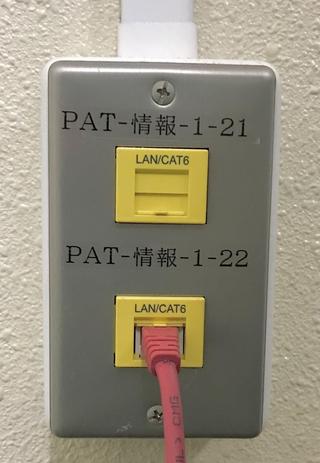
Each room in the university has an information outlet like the one in the photograph below. Connecting a LAN cable to it gives you a wired connection to the campus network. Which network you are connected to (a laboratory network, the guest network and so on) is managed by the Information and Media Center; by default you are connected to the guest network. On the guest network, a user authentication screen appears when you connect; enter the account name and password issued by the Information and Media Center. If you want to connect to a laboratory network rather than the guest network, obtain a subnet and then submit a VLAN change request (described below).
As you can see in the photograph, each information outlet carries a label (for example PAT-情報-1-21). If you have any trouble, such as being unable to connect, please contact the Information and Media Center and quote this label.
How to use a laboratory network
If you want to connect to the network (subnet) of your laboratory or your department (a division, graduate school, center and so on) rather than the guest network, first check your department's network operating policy with the faculty or staff member responsible for the network in your department (the network committee member). You need to check the following points.
- Check your department's policy on network connection. In most cases it is either 1. connect to your department's subnetor 2. obtain a dedicated subnet for your laboratory. See the relevant section below for details of each.
- Discuss obtaining a domain name for your laboratory. For details, see “Obtaining a laboratory domain” below.
1. Connecting to your department's subnet
In this case, a global IP address for your laboratory is allocated from your department's subnet. This suits cases where you need only a small number of global IP addresses (two or fewer per room). Then send aVLAN change requestto the Information and Media Center ( email address ). (In the subnet address field, enter your department's subnet address.)
2. Obtaining a dedicated subnet for your laboratory
If you are not allocated an address from your department's subnet, you obtain a subnet dedicated to your laboratory (133.15.x.0/25). On a laboratory subnet you can use the following routing services provided by the Information and Media Center, so you do not need to operate a router yourself. For details, seeRouting Service.
- Routing
Provides routing to the Internet and to other subnets within the university. This means you do not need to install a router. - Filtering
Lets you control access by IP address within the laboratory subnet. - DHCP server
Automatically assigns IP addresses to network devices connected to the laboratory subnet. - VLAN configuration
Lets you treat different rooms as a single network.
To obtain a subnet, fill in thesubnet address application formand send it to the Information and Media Center (email address). In the desired domain name field, enter the laboratory domain you intend to use. For details, see “Obtaining a laboratory domain” below.
Points to note when using the network
The subnet administrator is responsible for any security incident that occurs within the laboratory network.Notes on Using the Network Environmentcarefully and take care to prevent security incidents. The university also makesantivirus softwareavailable free of charge. On any computer you connect to the network, be sure toalwaysinstall antivirus software. Make sure that members of your laboratory, including students, do the same. If an incident such as a virus infection does occur, please refer tohereand contact the Information and Media Center promptly. You may need to take action as the subnet administrator.
Where to send application forms
| Send to (E-mail) |
net-registration * Append @imc.tut.ac.jp to the addresses above. |
|---|
Obtaining a laboratory domain
This section explains how to obtain a laboratory domain. A laboratory domain is required in order to set up a website or to use laboratory email addresses. Domain allocation at Toyohashi University of Technology is governed by thePolicy on the Allocation of Domains within the University, and each laboratory normally uses a domain of the form xx.yy.tut.ac.jp, where xx and yy denote the laboratory and the department respectively. When applying for a domain name, decide the xx part in consultation with your network committee member and ask the administrator of the yy.tut.ac.jp domain (who may also be the network committee member) to register it. A DNS server is required in order to manage the domain name you obtain. For details, see theDNS serversection below.
Hosting service
The Information and Media Center provides, as a hosting service, the various services needed to run a laboratory network, free of charge (except for the web server). Unless you have particular reasons not to, please consider using the hosting service. You may build your own server in your laboratory, but this is not recommended because of management problems such as security updates not being applied. For details of the hosting service and how to apply, seehere. Note that a laboratory domain is required in order to use the hosting service, so if you do not yet have one, obtain it as described in “Obtaining a laboratory domain” above. The following sections describe the individual services offered by the hosting service.
DNS server
A DNS server manages the correspondence between domain names and the IP addresses that identify devices connected to an IP network. A DNS server is needed, for example, in order to set up a website or send and receive email using your laboratory domain. If you use a DNS server, apply for the hosting service and then refer tohereto configure DNS.
If you do not use the hosting service, there are two other options. The first is to ask your department to manage your laboratory domain; in that case, consult your department's domain administrator or network committee member. The second is to set up your own authoritative DNS server in your laboratory, but this is not recommended for security reasons.
Mail server
A mail server is required in order to send and receive email using addresses in your laboratory domain (xx.yy.tut.ac.jp). Such addresses take the form example@xx.yy.tut.ac.jp, where the administrator of the laboratory domain is free to decide the “example” part. If you use the hosting service, mail addressed to example@xx.yy.tut.ac.jp is forwarded to the mailbox of the corresponding lifelong email address. A lifelong email address is an address on Gmail issued to members of Toyohashi University of Technology (faculty, staff and students). For details, seehere. The hosting service also lets you create simple mailing lists using mail aliases. For mail server configuration, seehere.
Mailing list server
In addition to the mail server described above, the hosting service also offers a full mailing list server based on Mailman. However, a simple mailing list using aliases is available with the mail server application alone, so please consider whether you really need a mailing list server, referring tohere, before applying.
Web server
The hosting service also provides web server functionality, for a fee (30,000 yen per year). You can use it to set up a laboratory website. The Information and Media Center manages the web servers provided through the hosting service, so users do not need to apply security updates themselves (this does not apply to content management systems such as WordPress that users install themselves). To use it, apply for the hosting service and then refer tohereto configure the web server. Use a WebDAV client to edit files on the web server.UPKIserver certificates issued byavailable free of chargeare available at no charge. You can use these to set up a website that supports encrypted communication (HTTPS). To use a server certificate, refer tohereand request one fromhere. You may also use a CMS, but because these are frequently targeted by attackers, please read thenotescarefully if you do.
Notes on installing your own server
On the Toyohashi University of Technology network, communication from inside the university to the outside (the Internet and so on) is generally permitted freely, with exceptions such as P2P and remote-control software. Communication from outside the university to the inside, however, is entirely blocked by the firewall. Therefore, if you install your own server in your laboratory that is to be published externally, aserver installation applicationis required. If a security incident is caused by a server installed for external publication, the person who installed it is responsible. Please take care to manage it properly, including applying security updates.